
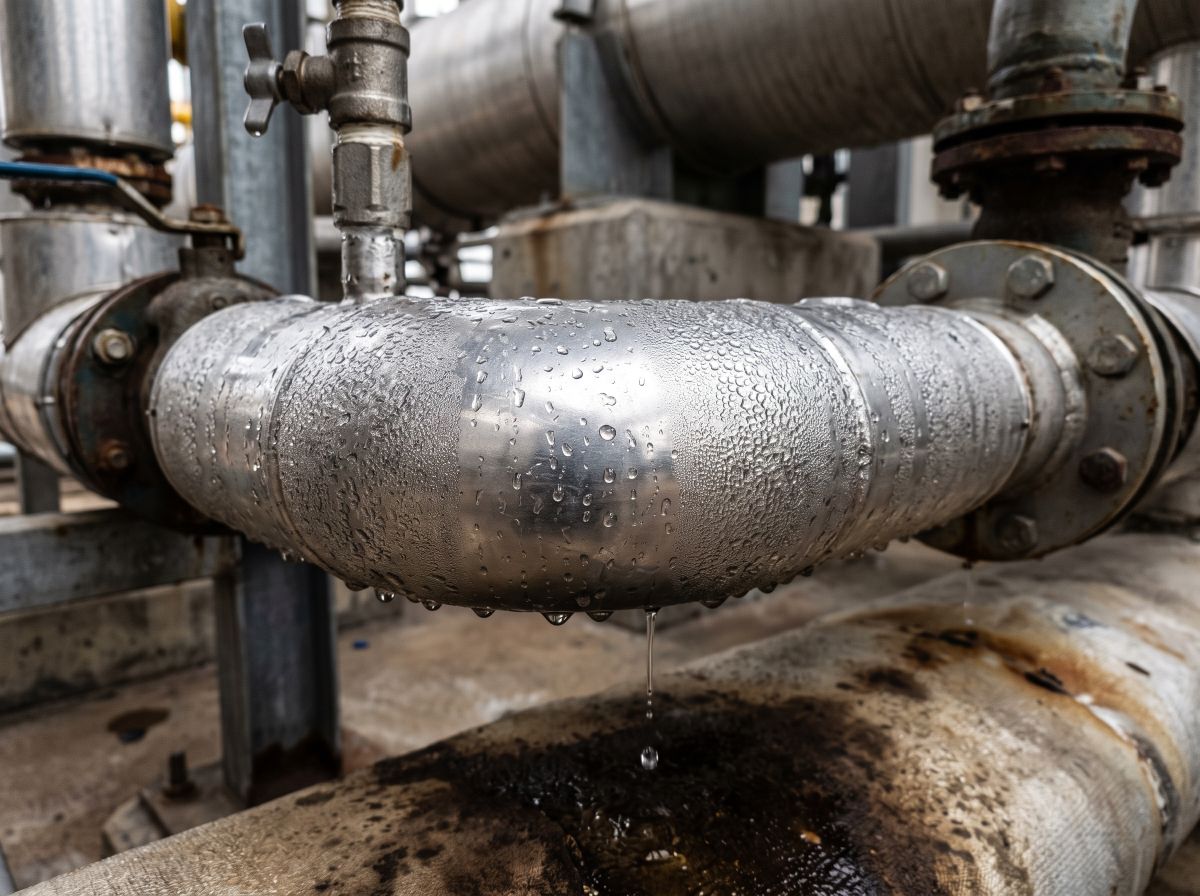
Condensation on below-ambient piping happens when the outer surface of an insulated cold line falls to the dew point of the air around it, and humid air gives up its moisture onto that surface. It is a design problem disguised as a maintenance problem. The water shows up as a stained ceiling tile, a slick spot on the floor, or a corroded hanger, and it gets chased as a leak for weeks – because almost nobody expects an insulated pipe to sweat.
Insulated pipes sweat all the time. Insulation is not a yes-or-no proposition on cold service; it is a thickness and a vapor-tight system, matched to the conditions in the room. Get either one wrong and the line will wet itself from the outside in, continuously, with no jacket damage required.
KEY ANSWERThe short version. Condensation forms whenever the insulation's outer surface reaches the dew point of the surrounding air. The thickness needed to prevent it is set mainly by ambient temperature and relative humidity, not by how cold the pipe is – a 38°F (3°C) line that needs 1/4" of elastomeric insulation at 80°F (27°C) and 50% relative humidity needs a full 1" at 90°F (32°C) and 80% relative humidity. Four things control the outcome: (1) design to your worst-case ambient conditions rather than your average, (2) use the condensation-control thickness rather than the energy-code minimum, (3) select a material that resists water-vapor transmission, and (4) keep the vapor retarder continuous – because once moisture reaches cold insulation, it does not dry out. |
What sweating on an insulated pipe is telling you
Air holds water in proportion to its temperature, and dew point is the temperature at which it becomes saturated and starts releasing that water as liquid. Air at 90°F (32°C) and 80% relative humidity has a dew point near 83°F (28°C), so any surface in that room colder than 83°F will collect water – including the outside of an insulated chilled water line.
That is the whole mechanism. Insulation on a cold line is not there to keep water out; it is there to keep the outer surface temperature above the dew point of the air touching it. Thickness is the lever that does that work.
Is it a leak or is it condensation?
Condensation tracks the weather. It appears along the whole cold surface rather than at one point, worsens on humid afternoons, eases when the air dries, and often shows up first at valves and fittings while the straight pipe stays dry. A leak ignores the humidity, concentrates at a joint or a defect, and persists overnight. If the wetting pattern follows the dew point, stop looking for a leak.
Three failure modes, three different fixes
When an insulated cold line sweats, one of three things has gone wrong, and the remedies are not interchangeable:
- The insulation is too thin for the conditions. The surface is below dew point. More thickness, or a lower-conductivity material, is the fix.
- The vapor retarder is breached. Humid air is migrating in and condensing against the cold pipe, inside the system, where nobody can see it. Thickness will not help; sealing will.
- The insulation is already wet. Its thermal performance has collapsed, the surface has dropped further below dew point, and the problem now feeds itself. Replacement is the fix.
Why ambient air, not pipe temperature, sets your thickness
Two identical 38°F (3°C) lines in two rooms down the hall from each other can require insulation thicknesses that differ by a factor of four. Nothing about the pipe changes. Only the air does.
Here is that effect in published product data, for a 6" outside diameter line at a constant 38°F (3°C) operating temperature:
|
Design conditions |
Minimum thickness |
Versus mildest case |
|---|---|---|
|
80°F (27°C), 50% RH |
1/4" |
– |
|
85°F (29°C), 70% RH |
1/2" |
2× |
|
90°F (32°C), 80% RH |
1" |
4× |
Aerocel EPDM, minimum thickness required to prevent condensation. All rows: low air movement, 38°F operating temperature, 6" pipe outside diameter. Published values are expressed as the range of pipe outside diameters served by each thickness; the 6" case is read out here for comparison.
Fiberglass behaves the same way, and more dramatically at the high-humidity end:
|
Ambient temperature |
70% RH |
80% RH |
90% RH |
|---|---|---|---|
|
90°F (32°C) |
1" (25 mm) |
1-1/2" (38 mm) |
3-1/2" (89 mm) |
|
80°F (27°C) |
– |
1-1/2" (38 mm) |
3" (76 mm) |
|
70°F (21°C) |
– |
1" (25 mm) |
2-1/2" (64 mm) |
Owens Corning SSL II with ASJ Max, thickness to prevent surface condensation at a 35°F (2°C) system operating temperature. Thickness in inches, millimetres in parentheses. Calculations estimated using NAIMA 3E Plus v4.0. Fixed design conditions: steel horizontal piping, 16" NPS, 0 mph wind speed, outer surface jacket emittance 0.9. Thermal conductivity values used are subject to normal manufacturing tolerances.
Read the 90°F row across: the same 35°F line needs 1" at 70% relative humidity and 3-1/2" at 90%. Humidity alone multiplies the material requirement by three and a half.
Those footnotes matter as much as the numbers. A thickness figure without its pipe size, wind speed, jacket emittance, and calculation method is a different answer to a different question. Always specify from data that states its design conditions.
Pipe size and mixed environments
Larger pipe needs more thickness at the same conditions: more surface area per linear foot and a flatter curvature mean a given wall does less work holding the surface above dew point. This is why condensation tables are organized by diameter, and why a thickness that worked on 1" tubing will not carry over to a 6" header.
The same logic applies along a single run. A line that leaves a mechanical room, crosses a ceiling plenum, and emerges outdoors has passed through three ambient conditions, and the plenum is frequently the worst – unconditioned and humid. The worst ambient condition on a run sets the thickness for that segment. Specify segment by segment rather than averaging across the run.
Energy-code thickness is not condensation-control thickness
These are two different calculations that produce two different numbers, and conflating them is the most expensive mistake in this category.
The minimum pipe insulation thicknesses tabulated in ASHRAE/IES Standard 90.1 exist to limit heat gain. They are derived from energy-efficiency considerations, and the standard's own table notes acknowledge that additional insulation is sometimes required for reasons the energy tables do not address. The ASHRAE Handbook chapter on insulation for mechanical systems says the same thing directly: thicknesses greater than the economic optimum may be required for condensation control, personnel protection, or noise control.
Condensation control is a separate calculation, run against your design dew point. The industry tool is NAIMA's 3E Plus software – the same program that generated the fiberglass table above. For below-ambient service, run both calculations and install the thicker of the two results.
KEY ANSWERThe specification takeaway. Meeting the energy code does not mean the line will stay dry. Run the condensation calculation at your worst-case ambient temperature and relative humidity, compare it against the code minimum, and install whichever is thicker. On chilled water, glycol, and refrigeration service, the condensation number usually wins. |
Editions change, so confirm which edition of 90.1 your project is built to. Going thicker than the calculation requires buys margin against worse-than-design conditions – cheap insurance on a line that is hard to get back to, but no substitute for a sound vapor retarder.
Choosing the material for below-ambient service
Above ambient, materials are ranked by thermal conductivity. Below ambient, the governing property is different: resistance to water-vapor transmission. A material that holds water against a cold pipe will fail regardless of how good its dry R-value looks on a data sheet, which is why closed-cell materials dominate cold service.
|
Material class |
Service range (standard scope) |
Moisture behavior |
Where it fits |
|---|---|---|---|
|
Flexible elastomeric, EPDM or nitrile (ASTM C534) |
Grade 1: −297°F to 220°F (−183°C to 104°C) |
Closed-cell; inherently low vapor permeability |
Chilled water, refrigeration, glycol, condensate; tube and sheet. EPDM has better inherent UV and ozone resistance for exposed outdoor runs; nitrile generally needs a protective coating or jacketing outdoors |
|
Rigid polyisocyanurate (ASTM C591) |
−297°F to 300°F (−183°C to 149°C) |
Closed-cell; low absorption |
Larger-diameter cold lines, low-temperature process |
|
Cellular glass (ASTM C552) |
−450°F to 800°F (−268°C to 427°C) |
Closed-cell, non-absorbent and impermeable to liquid water and vapor |
The standard answer at the cryogenic end, and anywhere water exposure is likely; relies on sealed joints |
|
Fiberglass with a factory vapor-retarder jacket |
Product-dependent; see data sheet |
Absorbent; performance depends entirely on jacket integrity |
Cold service where the system can be sealed and stays dry |
|
Phenolic foam |
Product-dependent; see data sheet |
Closed-cell; low conductivity per inch |
Space-constrained cold runs |
Ranges are the scope-level limits in the current material standards. Individual products carry their own rated ranges, which are often narrower, and the standards themselves note that actual limits for a specific application are agreed between manufacturer and purchaser. Specify from the product data sheet, and verify a specific product's UV rating rather than relying on the polymer family.
As temperatures drop, the vapor drive across the insulation rises and the options narrow. Below roughly −40°F, multi-layer systems with staggered joints become normal rather than optional, because a single continuous seam through the full wall thickness is a direct path for vapor.
Can you use fiberglass on cold lines?
Yes, with a condition attached. Fiberglass is absorbent, so on below-ambient service it works only with an intact factory-applied vapor-retarder jacket and a properly sealed system. That's why fiberglass pipe insulation ships with a condensation-thickness table. The material is thermally capable and cost-effective; the jacket is what makes it viable, and the jacket is also the single point of failure. Where washdown, outdoor exposure, or rough service make jacket damage likely, a closed-cell material is more forgiving.
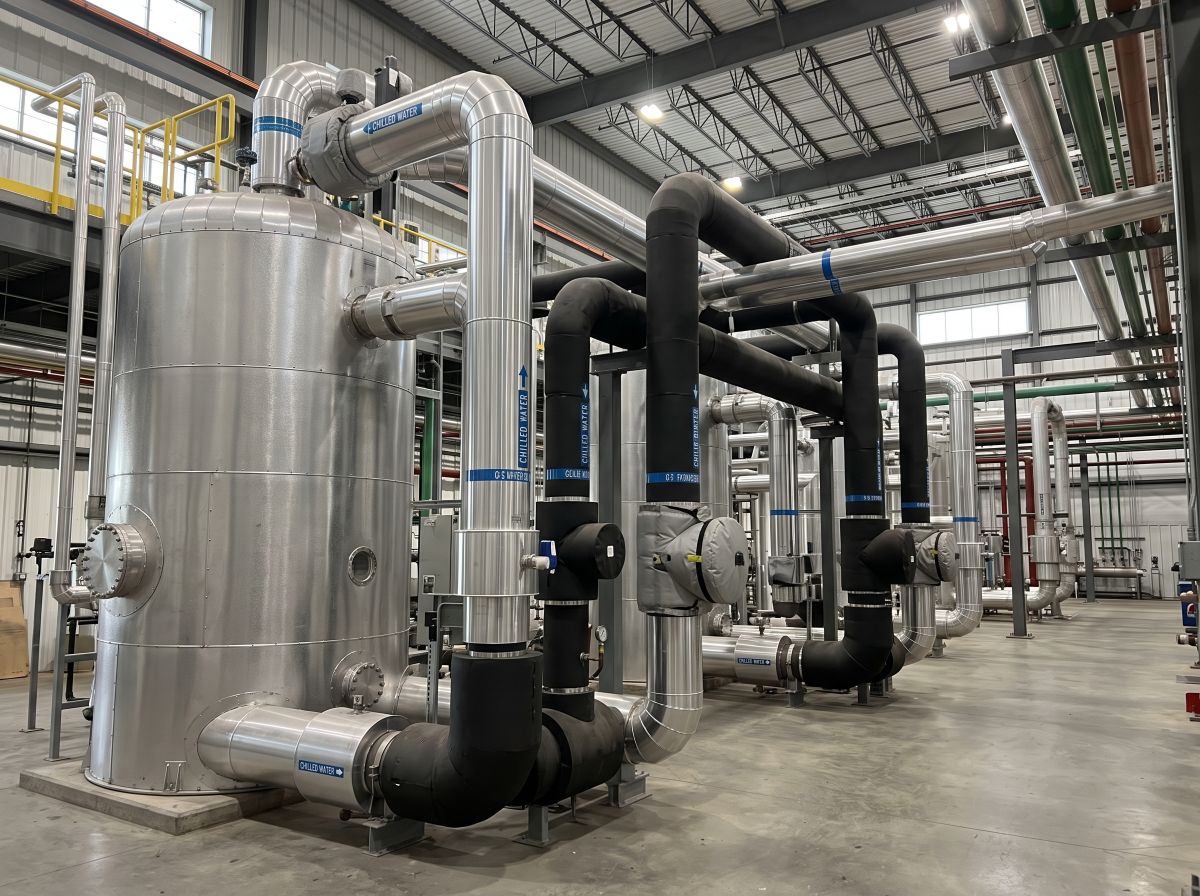
The vapor retarder is the system, and it is where cold jobs fail
On a cold line, the vapor retarder goes on the outside – the warm side. This is the reverse of building-envelope intuition, where the retarder faces the heated interior, and it is a common source of field error. The rule is consistent: the retarder always faces the warm side, and on below-ambient piping the warm side is the ambient air.
A vapor retarder is only as good as its continuity. One breach wets the whole system, from the inside, invisibly. The failure points are predictable:
- Butt joints, seams, and terminations – every joint is a potential path, and an unsealed end is a chimney. Seal with the manufacturer's specified adhesive, tape, or mastic, and verify the accessory is compatible with the insulation; solvent-based products can attack some foams.
- Hangers and supports – bare metal through the insulation is a thermal and vapor bridge, and a reliable condensation site. Load-bearing inserts and isolation shields keep the system continuous where the pipe is carried.
- Valves, flanges, strainers, and pumps – irregular geometry is hard to seal, which is why the symptom is so often "the straight pipe is dry, but the valves are wet." These need fabricated covers or a careful field detail, not a wrap and a hope.
- Penetrations and long runs – the retarder has to carry through a wall or floor sleeve unbroken, with the annular space sealed. On long runs, periodic vapor stops limit how far moisture travels if a breach occurs upstream, turning a whole-system loss into a local repair.
ASTM C1136 is the specification governing flexible vapor retarders for thermal insulation. It sets a water-vapor permeance of 0.10 perm or lower, surface burning characteristics of 25 flame spread and 50 smoke developed or lower, and classifies retarders by type according to retardance and strength. If a submittal does not reference it, ask why.
Removable blankets and wet-insulation repairs
Removable covers work on cold service, but the specification differs from the hot-side blanket most buyers have handled: a cold-service cover needs a vapor-tight outer facing and closures that seal rather than merely fasten, or it becomes a moisture trap around the fittings that are hardest to dry out. Specify them as cold-service assemblies explicitly.
As for repairs, a small, isolated, recent breach can be cut out and patched. A run that has been wet long enough to saturate is a different situation: the material has lost its thermal performance permanently, and the pipe surface underneath needs inspection before anything goes back over it. Patching that run buys very little.
What condensation costs before anyone notices it
Corrosion under insulation
Wet insulation held against cold steel is a textbook mechanism for corrosion under insulation. On cold and cyclic service, condensation is continuous and internal – no jacket damage is needed for it to start, and a degraded cold-service vapor retarder does the most damage with the least visible warning. On austenitic stainless, moisture plus leachable chlorides from the insulation is the specific condition that drives external chloride stress corrosion cracking.
Lost thermal performance, permanently
Wet insulation conducts heat far better than dry insulation, because water has displaced the air in the pore structure. Published testing on fiberglass pipe insulation has measured thermal conductivity rising to roughly three times its dry value at about 12% moisture by volume. On a cold line, this loss is effectively permanent, because the system never gets warm enough to drive the moisture back out. The colder surface that results pulls more condensation, which is the self-accelerating loop in failure mode three.
Facility damage, safety, and audits
Stained and collapsed ceiling tiles, corroded hangers and supports, rusted equipment beneath the run, and standing water on walking surfaces. The slip hazard is the one that tends to get a work order written.
In food, beverage, and pharmaceutical facilities, standing water and microbial growth on insulation are audit findings, not inconveniences. That argument moves a purchase order faster than any energy calculation, and it is worth making first if your facility is audited.
The internal case is usually straightforward: the cost of material and labor for a correctly specified system, against the cost of one corrosion-driven line replacement, plus the cooling energy lost through wet insulation in the meantime.
What to send a supplier so you get the right material the first time
Nobody can tell you a thickness without your conditions. Five numbers turn a vague worry into a quotable specification:
- Line operating temperature – the actual process temperature, not the setpoint on a drawing.
- Worst-case ambient temperature at the pipe – in the space the pipe actually occupies, which is often hotter than the occupied space.
- Worst-case relative humidity at the pipe – the August afternoon, not the annual average.
- Pipe size and type – NPS steel, copper tube, or stainless, with the nominal size.
- Indoor or outdoor, and air movement – wind speed changes the calculation, and outdoor runs add UV and weather requirements.
With those, a supplier runs the condensation calculation, returns a thickness and a material, and supplies the submittal data your project engineer needs for approval. Add linear footage and a fitting count, and you have a material take-off.
What else to settle before the order
- Stock versus special order. Thick walls on large-diameter pipe are frequently not stock items. Ask before you build a schedule around them.
- Fabricated fitting covers. Pre-fabricated covers for elbows, tees, valves, and flanges cost more per piece than field-cutting and usually cost less installed, with a better vapor seal on exactly the geometry that fails most.
- Accessories, ordered with the insulation. Adhesive, seam tape, mastic, jacketing, bands, and load-bearing inserts. A cold system is only vapor-tight if the accessories arrive with it.
- Submittal data. Request the condensation-thickness table and product data up front, so engineering approval is not what holds up the job.
One more thing worth doing before you compare quotes: normalize them to the same design conditions. If one vendor calculated at 85°F and 70% relative humidity and the other at 90°F and 80%, the thicknesses answer different questions, and the prices are not comparable.
Frequently asked questions
How thick does pipe insulation need to be to prevent condensation?
It depends on ambient temperature, relative humidity, and pipe diameter far more than on pipe temperature. A 38°F line at 6" outside diameter needs 1/4" of elastomeric insulation at 80°F and 50% relative humidity, and 1" at 90°F and 80% relative humidity. Run the calculation at your worst-case conditions rather than working from a rule of thumb.
Why is my insulated pipe still sweating?
One of three things has gone wrong: the insulation is too thin for the ambient conditions, the vapor retarder has been breached and humid air is condensing inside the system, or the insulation is already wet and has lost its thermal performance. Each has a different fix, so identify which one before buying material.
Which side does the vapor barrier go on for cold pipe?
The outside. The vapor retarder always faces the warm side, and on a below-ambient line the warm side is the surrounding air – the reverse of building-envelope practice. It must be continuous through joints, hangers, fittings, penetrations, and terminations, because a single breach can wet the entire system from within.
Does insulation dry out after it gets wet?
Not on a cold line. A below-ambient system never gets warm enough to drive moisture back out, so wet insulation stays wet, its conductivity stays elevated, and its outer surface sits further below dew point – which pulls still more condensation. Wet cold-service insulation is replaced, not dried.
Is energy-code insulation thickness enough to prevent condensation?
No. The minimum thicknesses in ASHRAE/IES Standard 90.1 are based on energy-efficiency considerations, and the standard itself notes that more insulation is sometimes needed for other reasons. Condensation control is a separate calculation run against your design dew point. Install whichever of the two results is thicker.
What insulation is best for chilled water and refrigeration lines?
Closed-cell materials are the default, because below ambient the governing property is resistance to water-vapor transmission rather than R-value per inch. Flexible elastomeric EPDM or nitrile covers most chilled water and refrigeration service, rigid polyisocyanurate suits larger diameters, and cellular glass handles cryogenic temperatures and wet environments.
Working with The Insulation Guy
Most condensation guidance comes from a company with one product to sell, which is why so much of it concludes that the answer is that product. The Insulation Guy supplies 13 types of industrial pipe insulation across the full temperature range, jacketed and unjacketed, plus the accessories and fabricated covers that make a cold system vapor-tight, so we can match recommendations to the service rather than a catalog.
Send us your line temperature, worst-case ambient conditions, and pipe sizes, and we will come back with a thickness, a material, and the submittal data your engineer needs. We ship nationwide.