
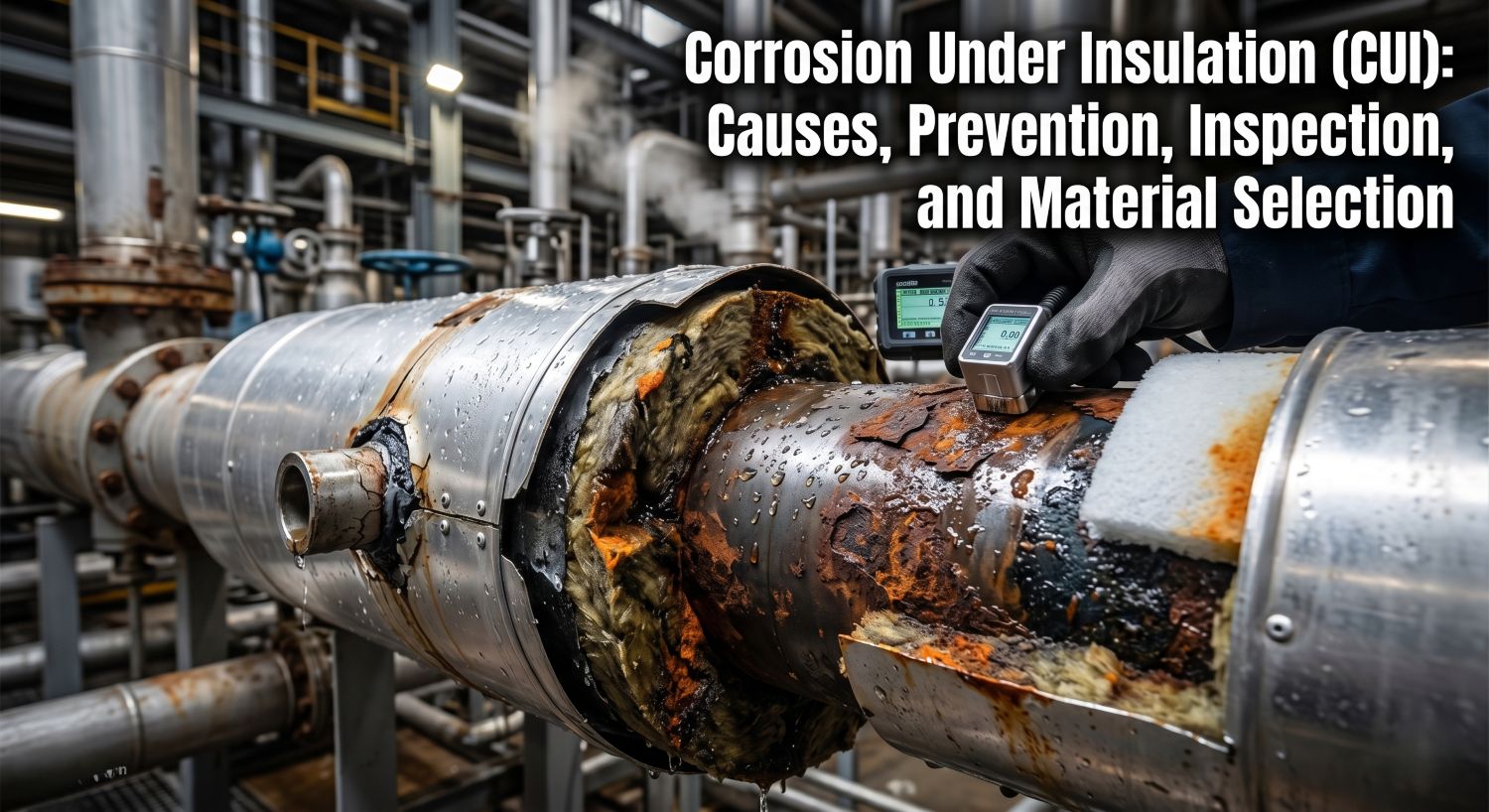
Corrosion under insulation (CUI) is the corrosion of piping, vessels, tanks, and structural steel that occurs underneath thermal insulation when water becomes trapped against the metal surface. It is one of the most expensive and dangerous integrity problems in industrial facilities precisely because it is hidden: the damage progresses out of sight, beneath an intact-looking jacket, until a leak, a failed inspection, or an unplanned shutdown reveals it.
|
KEY ANSWER The short version. CUI needs three things to happen: water, a metal surface in the vulnerable temperature range, and time. Control any one of them and you control the corrosion. The four levers facility owners actually pull are (1) choosing insulation that does not hold water or shed corrosive chlorides, (2) keeping the weather barrier and vapor barrier intact, (3) inspecting on a risk-based schedule before damage becomes failure, and (4) understanding the corrosion mechanism well enough to design it out from the start. |
1. The science of CUI: how moisture gets trapped and what it does
Insulation does not cause corrosion. Trapped water does. Insulation simply creates the annular space where water can collect, hold against the pipe, and stay there long enough to do damage — often while keeping that water warm enough to accelerate the reaction. Understanding the mechanism is what makes every prevention decision downstream make sense.
How water gets in
Water reaches the metal surface from more sources than rain. The common entry points are:
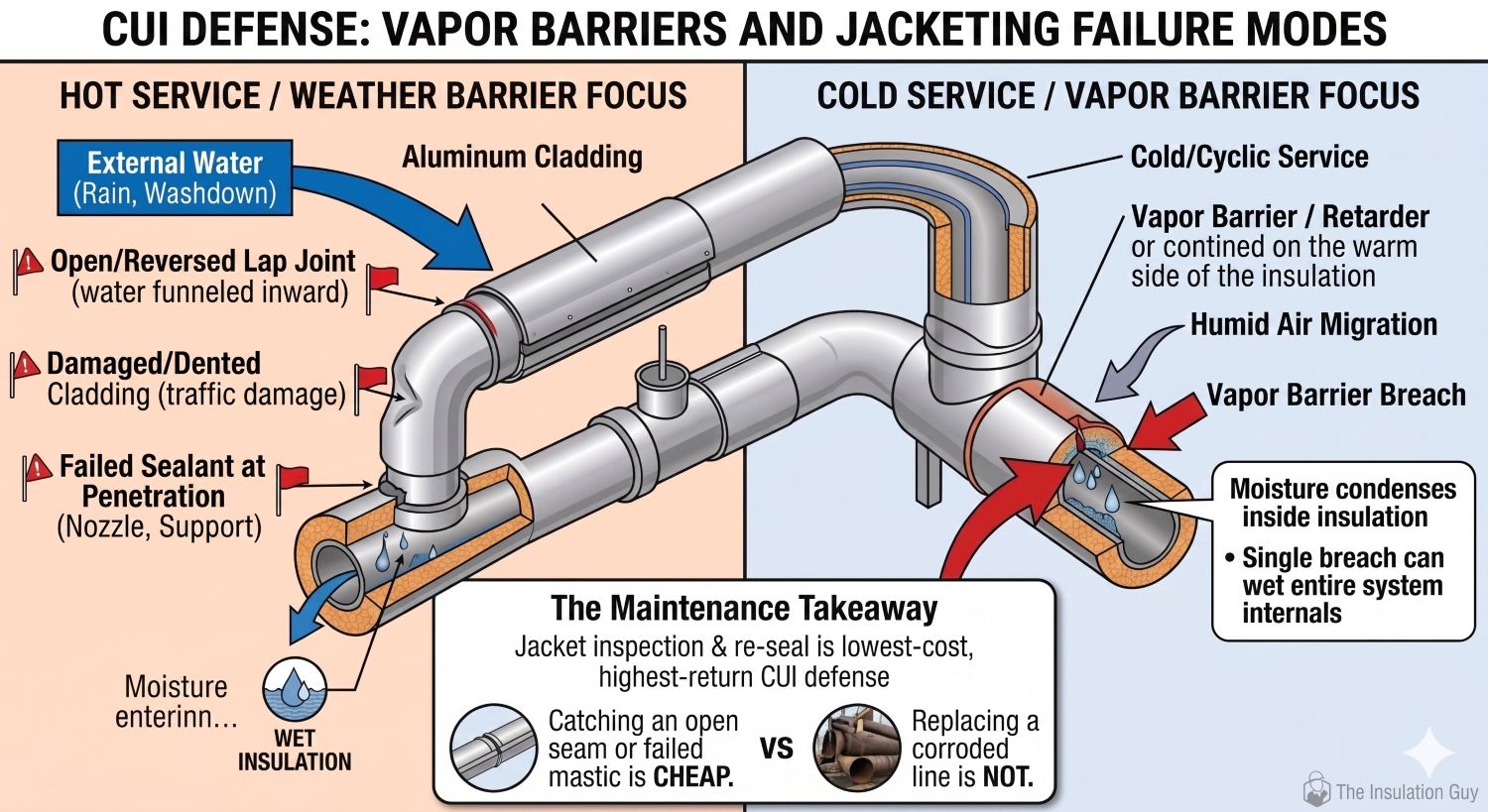
- External water — rain, washdown, cooling-tower drift, deluge-system testing, steam leaks, and sprinkler discharge entering through damaged cladding, open seams, failed caulking, or penetrations.
- Condensation — on cold and cyclic service, humid air reaches the cold surface below its dew point and condenses inside the insulation. This is continuous and internal; no jacket damage is required for it to occur.
- Trapped construction or process moisture — water that entered during installation, hydro-testing, or a process upset and never had a path to dry out.
Why it stays — and why that is the real problem
Once water is inside the system, insulation works against you. It holds the moisture in contact with the steel, slows evaporation, and on hot service keeps the water warm — which speeds up the electrochemical reaction. A wet insulation system is not a one-time event; it becomes a sustained corrosion cell.
The temperature window
CUI is temperature-driven. Carbon steel is generally considered vulnerable across roughly 25°F to 350°F (−4°C to 175°C), with the most aggressive attack near the middle of that band and on equipment that cycles in and out of the range. Equipment that runs continuously hot enough to keep the surface dry, or cold enough to keep water frozen, sits at lower risk — but cyclic and intermittent service is the worst case because it repeatedly wets, warms, and re-wets the surface.
Two metals, two failure modes
CUI is not a single reaction. The mechanism depends on the metal:
|
Material |
Dominant CUI mechanism |
What it looks like |
|---|---|---|
|
Carbon & low-alloy steel |
General and localized (pitting) corrosion driven by trapped oxygenated water; accelerated by chlorides and sulfur compounds and by acidic conditions (e.g., carbonic acid). |
Wall loss, pitting, scabbing rust under the insulation; eventual through-wall leaks. |
|
Austenitic stainless steel |
External chloride stress corrosion cracking (ESCC / CSCC) — chlorides concentrate as water evaporates and crack the steel under tensile stress. |
Fine branching cracks, often with little visible metal loss; can fail suddenly. |
This is why "which insulation should we use" is a corrosion-engineering question, not just a thermal one. Stainless lines in particular are sensitive to the chlorides an insulation material can leach when it gets wet — which leads directly to material selection.
2. Preventative material selection: designing CUI out from the start
The cheapest CUI to fix is the CUI you never get. Material selection is the highest-leverage prevention decision because it is made once, at design or re-insulation, and then protects for the life of the system. Two properties matter most: how the material behaves around water, and what it leaches when wet.
Material selection is one of five recognized levers for controlling CUI — alongside equipment design that sheds water, protective coatings applied to the metal before insulation, intact weather and vapor barriers, and ongoing maintenance and inspection. This page focuses on the insulation-side decisions a distributor influences directly; coatings and design are complementary layers worth coordinating within the same program.
Water behavior: shed it, don't store it
Insulation materials handle moisture very differently. The goal is a system that resists absorbing water and lets any water that does enter drain and dry rather than pool against the steel.
|
Material class |
Moisture behavior |
Typical CUI consideration |
|---|---|---|
|
Cellular glass |
Closed-cell, effectively non-absorbent and impermeable to liquid water and vapor. |
Strong choice where water exposure is likely; relies on sealed joints. |
|
Aerogel blanket |
Hydrophobic; repels liquid water while remaining breathable. |
Sheds water and dries; thin profile for tight spaces. |
|
Calcium silicate |
Absorbent unless treated; can hold water against steel. |
Often specified with corrosion inhibitors; manage water ingress carefully. |
|
Mineral wool / fiberglass |
Absorbent; performance depends heavily on jacket integrity. |
Cost-effective thermally; pair with a robust weather/vapor barrier. |
|
Perlite |
Absorbent unless treated; available in water-repellent, inhibited grades. |
Specify treated grades for wet or cyclic service. |
|
Polyisocyanurate (rigid) |
Closed-cell; low absorption, common on cold service. |
Watch joint sealing and temperature limits. |
Leachable chlorides: protecting stainless steel
For austenitic stainless, the material's chemistry matters as much as its water behavior. When insulation gets wet, soluble chlorides can leach out of the material and concentrate on the steel surface — the exact condition that triggers chloride stress corrosion cracking. Specifying low-leachable-chloride insulation (and materials that contain inhibiting ions such as silicate) is the standard defense.
The relevant test and specification framework:
- ASTM C795 — specification for thermal insulation intended for use over austenitic stainless steel; sets the chloride/inhibitor requirements.
- ASTM C871 — the test method for leachable chloride, fluoride, silicate, and sodium ions used to qualify materials against C795.
3. Inspection and NDT: finding CUI without stripping the insulation
You cannot manage what you cannot see, and CUI is invisible by definition. Stripping all insulation to inspect is slow, expensive, and itself a source of damage and re-insulation cost. Modern CUI programs combine targeted insulation removal with non-destructive techniques that see through or around the jacket, prioritized by risk.
Start with risk, not with the whole plant
Because 100% inspection is impractical, the accepted approach is risk-based: concentrate effort on the circuits most likely to have CUI and most consequential if they fail. That means lines in the temperature window, with damaged or aging jackets, at penetrations and low points, on cyclic service, and near sources of water.
Non-destructive techniques
|
Technique |
What it does |
Best for |
|---|---|---|
|
Visual inspection (targeted) |
Direct look at damage points, penetrations, and through small windows or removed sections. |
First-pass screening and confirming findings. |
|
Profile / real-time / digital radiography |
X-ray imaging through the insulation to reveal wall loss and standing water. |
Small-bore pipe, elbows, and detecting trapped water. |
|
Pulsed eddy current (PEC) |
Measures average wall thickness through insulation and cladding without removal. |
Screening long runs and larger-diameter pipe/vessels. |
|
Guided wave UT (GWUT) |
Sends ultrasonic waves long distances along a pipe from one test point. |
Inaccessible or buried runs; locating areas to examine closely. |
|
Neutron backscatter |
Detects hydrogen — i.e., moisture — inside the insulation. |
Finding wet insulation before it has corroded the steel. |
|
Infrared thermography |
Images surface-temperature differences caused by wet insulation. |
Wide-area screening to flag suspect zones. |
No single method is complete. Programs typically screen broadly (thermography, PEC, neutron backscatter), then confirm with radiography or local insulation removal plus direct UT at the flagged locations.
4. The role of vapor barriers and jacketing: the first line of defense
If material selection decides how the system behaves when it gets wet, the weather barrier and vapor barrier decide whether it gets wet at all. A compromised jacket is where most CUI begins — and where most of it can be prevented with maintenance rather than replacement.
Weather barrier vs. vapor barrier
- Weather barrier (cladding/jacketing) — the outer metal or polymeric jacket that keeps liquid water out: rain, washdown, drift. Its job is to shed water before it ever reaches the insulation.
- Vapor barrier/retarder — on cold and cyclic service, a continuous barrier on the warm side that stops humid air from migrating inward and condensing on the cold surface. A single breach in a cold-service vapor barrier can wet the entire system from the inside.
Where jackets fail
CUI inspectors look at the same failure points every time. They are predictable, and they are maintainable:
- Open or reversed lap joints that funnel water inward instead of shedding it.
- Failed sealant and mastic at penetrations — nozzles, supports, hangers, instrument connections.
- Damaged or dented cladding from traffic, scaffolding, and foot traffic on horizontal runs.
- Missing or poorly terminated jacketing on undersides, dead legs, and low points where water collects.
- Degraded vapor barriers on cold service — the failure that does the most damage with the least visible warning.
|
KEY ANSWER The maintenance takeaway. A jacket inspection and re-seal program is one of the lowest-cost, highest-return CUI defenses available. Catching an open seam or failed mastic is cheap; replacing a corroded line is not. |
Frequently asked questions
What is corrosion under insulation (CUI)?
CUI is corrosion of piping, vessels, and equipment that occurs underneath thermal insulation when water becomes trapped against the metal surface. It is especially dangerous because it stays hidden beneath an intact-looking jacket and is often found only after a leak or a failed inspection.
What causes corrosion under insulation?
CUI requires three conditions together: water reaching the metal, a surface temperature in the vulnerable range, and enough time. Water enters from rain, washdown, steam leaks, or condensation on cold service, and the insulation then holds it against the steel where it corrodes.
What is the temperature range for corrosion under insulation?
Carbon steel is generally at risk from roughly 25°F to 350°F (−4°C to 175°C), with cyclic and intermittent service the worst case. Equipment that stays hot enough to remain dry, or cold enough to keep water frozen, sits at lower risk.
How can you prevent corrosion under insulation?
Prevention works on five fronts: selecting the right insulation, sound equipment design that sheds water, protective coatings on the metal beneath the insulation, intact weather and vapor barriers, and routine maintenance and inspection. No single measure is enough on its own — CUI control is a layered strategy.
What type of insulation helps prevent CUI?
Materials that resist holding water — such as cellular glass and hydrophobic aerogel — and, for stainless steel, low-leachable-chloride materials qualified to ASTM C795/C871. The goal is insulation that sheds and drains water rather than storing it against the steel.
How do you inspect for CUI without removing the insulation?
Several non-destructive techniques see through or around the jacket: profile and digital radiography, pulsed eddy current, guided wave ultrasonics, neutron backscatter for moisture, and infrared thermography. Programs screen broadly, then confirm at flagged spots with radiography or targeted insulation removal.
How much does corrosion under insulation cost?
CUI is one of the most expensive integrity problems in process facilities. Industry estimates have attributed roughly 40 to 60 percent of total pipe maintenance costs to CUI, and a single undetected failure can trigger an unplanned shutdown that dwarfs the cost of prevention.
Does stainless steel get corrosion under insulation?
Yes. Austenitic stainless is vulnerable to external chloride stress corrosion cracking, where chlorides leaching from wet insulation concentrate on the surface and crack the steel — which is why low-chloride insulation is specified over stainless.
Working with The Insulation Guy
Most CUI guidance comes from companies selling one product. The Insulation Guy supplies the full range of industrial insulation materials, which means the recommendation is matched to the service — the right material for the temperature, the moisture exposure, and the metal — rather than to a single product line. For help specifying CUI-resistant insulation for a specific application, reach out to our team.