Quick Answer: High-temperature insulation refers to materials engineered to maintain thermal stability and structural integrity in environments exceeding 1,000°F (538°C). These systems protect personnel from burn hazards, prevent energy loss in process heat applications, and manage extreme temperatures in equipment ranging from steam pipes and valves to industrial furnaces, turbines, and exhaust manifolds.
Choosing the right high-temp insulation comes down to three factors: the continuous operating temperature of your equipment, the physical constraints of the installation, and the regulatory standards that apply to your facility. A 350°F steam line calls for a fundamentally different solution than a 2,000°F furnace breeching — and specifying the wrong material costs money at best and creates a safety incident at worst.
This guide walks through the materials, applications, design anatomy, and standards that govern high-heat thermal management so you can specify with confidence.
Why High-Heat Management Matters
Insulation is not a commodity expense. In high-temperature environments, it is the single most cost-effective engineering control available for four outcomes that every facility manager is measured on: worker safety, energy efficiency, asset longevity, and noise mitigation.
Personnel Safety
OSHA 29 CFR 1910.261 and related general-industry standards require employers to control "touch temperatures" on accessible equipment surfaces. Any uninsulated surface above 140°F can cause a first-degree burn within five seconds of contact. A properly specified removable insulation blanket produces a touch-safe surface temperature, eliminating the burn hazard without limiting maintenance access.
Operational Efficiency
Uninsulated valves, flanges, and fittings are the single largest source of energy loss in most industrial steam and process-heat systems. High-performance insulation reduces radiant and convective heat loss on high-heat systems by up to 90 percent. On a 6-inch, 350°F steam line, that translates to measurable reductions in fuel consumption and boiler load — and the payback period for insulating a single bare valve is typically under 12 months.
CUI Prevention
Corrosion Under Insulation (CUI) is the leading cause of pipe failure in process industries. It occurs when moisture becomes trapped between the pipe surface and the insulation, accelerating corrosion in a concealed location. Removable, properly drained insulation jackets — as opposed to permanent cement or mastic systems — allow for routine inspection, which is the only reliable defense against CUI. Our custom-fabricated blankets are engineered to come off cleanly and go back on without degradation.
Acoustic Control
High-density mineral wool and layered composite blankets also dampen the broadband noise generated by turbines, compressors, blowers, and high-velocity steam lines. In facilities where OSHA noise exposure limits are a concern, a dual-purpose thermal/acoustic blanket can resolve both issues with a single engineered product.
Materials & Temperature Ratings Guide
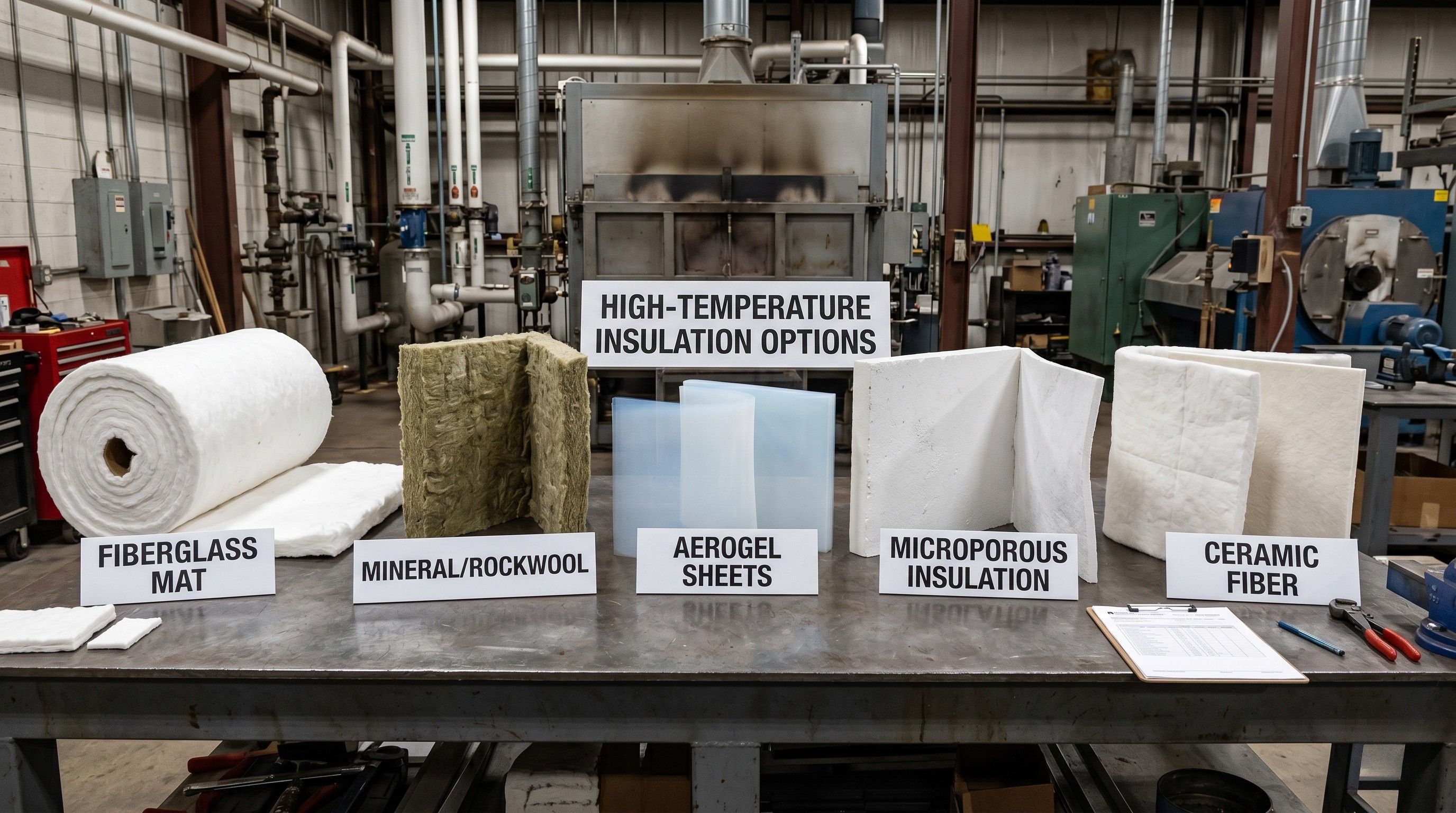
The table below summarizes the five most common high-temperature insulation materials, their maximum continuous service temperatures, and the applications each is best suited for. Maximum temperatures are continuous-duty ratings; peak or intermittent ratings are typically higher.
|
Material Type |
Max Continuous Temp |
Best For |
|---|---|---|
|
Fiberglass Mat |
~1,000°F |
General-purpose steam and hot water systems; economical pipe and equipment coverage |
|
Mineral Wool / Rock Wool |
~1,200°F |
Outdoor and fire-rated applications; better moisture resistance than fiberglass |
|
Aerogel Sheets |
~1,200°F |
Tight spaces and space-constrained piping where thermal performance per inch is critical |
|
Microporous Insulation |
~1,800°F |
Extreme heat combined with severe space restrictions; highest thermal performance per inch of thickness |
|
Ceramic Fiber |
2,000°F – 2,300°F+ |
Turbines, exhaust systems, furnace components, reactors, and breechings |
Specification note: Continuous temperature ratings assume steady-state operation. If your process cycles or includes spike conditions, size to the peak, not the average. A material rated for 1,200°F continuous duty that sees 1,350°F spikes is being run outside its design envelope and will degrade prematurely.
Core Applications for High-Temp Systems
High-Heat Machinery
Turbines, engine exhaust manifolds, and high-performance pumps generate some of the most extreme surface temperatures in any industrial facility — often exceeding 1,500°F. These assets require custom-fabricated removable jackets engineered around the geometry of the specific equipment, because off-the-shelf pipe wraps cannot conform to complex shapes without creating thermal bridges and hot spots.
Industrial Pipe Systems
Pipe insulation is the largest category of high-temp work by volume. Our fabricated systems cover the full industrial range — from -300°F cryogenic lines up to +2,300°F refractory piping — and are sized from the field to account for elbows, tees, reducers, and support hardware. Removable sections at every flange, valve, and instrument port make inspection and maintenance practical rather than painful.
Flow Control & Pressure Vessels
Valves, flanges, pressure relief valves (PRVs), expansion joints, and boiler manways are the single biggest source of heat loss in most steam systems because they are almost always left bare. Custom-fabricated jackets for these components deliver the highest ROI in the entire facility — a single insulated 6-inch gate valve can save more energy annually than ten feet of insulated pipe.
Specialty Environments
Pharmaceutical, food-grade, and cleanroom facilities require insulation systems that tolerate repeated caustic washdowns, clean-in-place chemistries, and steam sterilization cycles. PTFE-coated fabric jackets provide the chemical resistance and smooth cleanable surface these environments demand, while still delivering the thermal performance the process requires.
Technical Anatomy: The "Sandwich" Design
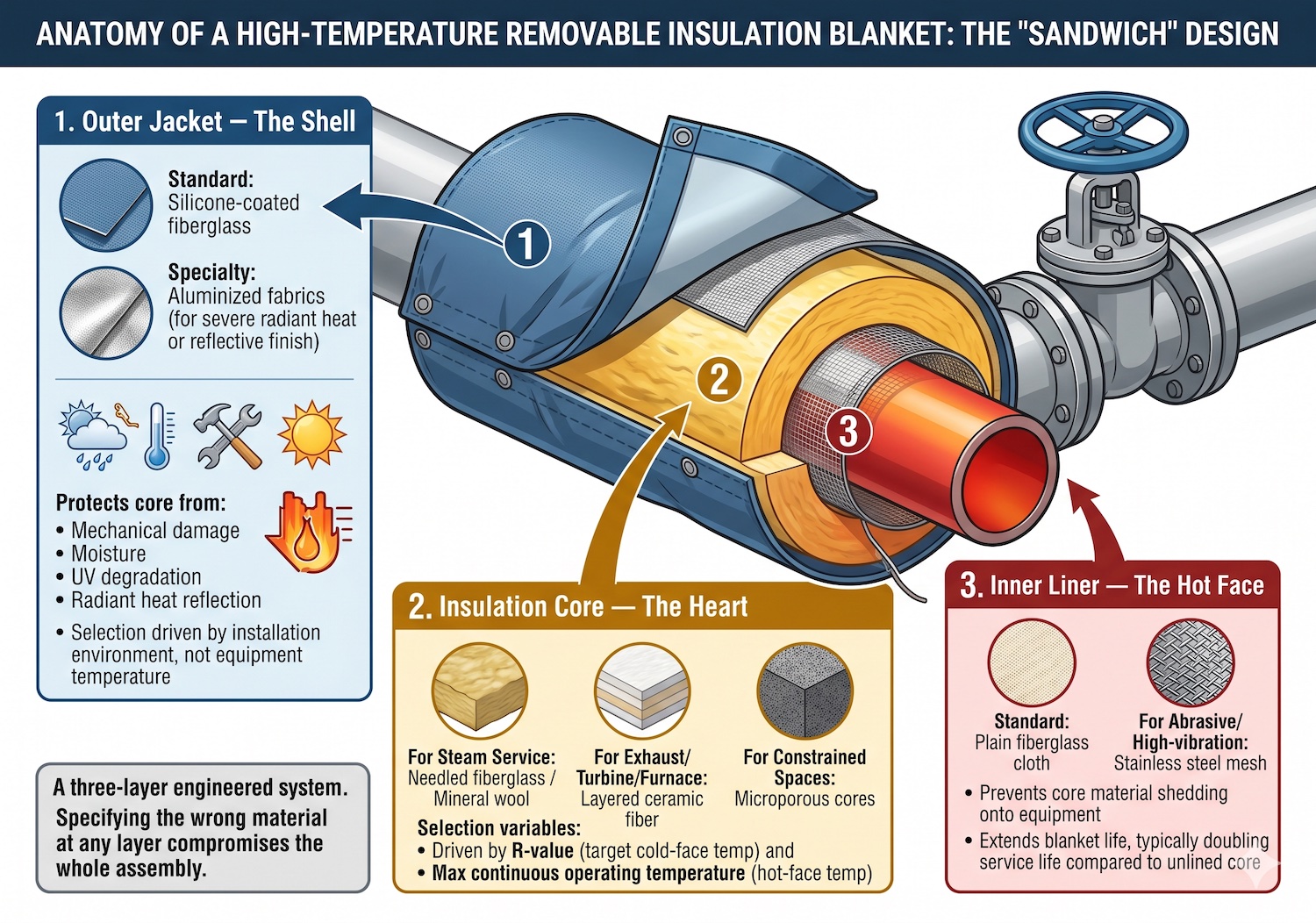
A high-temperature removable insulation blanket is a three-layer engineered system. Each layer has a distinct job, and specifying the wrong material at any layer compromises the performance of the whole assembly.
Outer Jacket — The Shell
The outer jacket protects the insulation core from mechanical damage, moisture, UV degradation, and radiant heat reflecting back from adjacent surfaces. Silicone-coated fiberglass is the workhorse material for most industrial environments. Aluminized fabrics are specified where radiant heat load is severe or where aesthetic requirements call for a reflective finish. Jacket selection is driven by the installation environment — outdoor, wet, caustic, or high-vibration — not by the temperature of the equipment underneath.
Insulation Core — The Heart
The core is the thermal barrier itself. Material selection is driven by two variables: the R-value required to hit the target cold-face temperature, and the maximum continuous operating temperature the hot face will see. For most steam service, needled fiberglass or mineral wool at appropriate thickness is the right answer. For exhaust, turbine, and furnace work, layered ceramic fiber is standard. Microporous cores are specified when space is so constrained that conventional material thicknesses will not fit.
Inner Liner — The Hot Face
The inner liner sits in direct contact with the hot equipment surface and must survive whatever the core material is rated for. Stainless steel mesh is specified for abrasive or high-vibration applications where a fabric liner would wear through. Plain fiberglass cloth is the standard for most other service. A correctly specified hot face prevents core material from shedding onto the equipment and extends blanket life measurably — typically doubling service life compared to an unlined core.
Industry Standards & Regulatory Compliance
High-temperature insulation work is governed by a set of ASTM standards and OSHA rules that specifiers should know by reference. The three below are the most commonly cited in industrial scopes of work.
ASTM C1695
The governing specification for flexible removable and reusable insulation blankets for hot service from ambient up to 1,000°F. C1695 covers construction, labeling, performance testing, and the basic requirements a fabricated blanket must meet to be considered compliant. When a spec sheet references "hot service removable insulation," this is the standard behind it.
ASTM C1129
The standard practice for estimating heat savings from insulating above-ambient pipes and equipment. C1129 provides the methodology engineers use to build the ROI case for a given insulation project — inputs, calculation procedures, and expected savings. This is the standard to cite when you need to justify a capital request for a facility-wide insulation upgrade.
ASTM C1055
Establishes safe touch-temperature thresholds and the test methodology for burn hazard assessment. C1055 is the reference point for the 140°F touch-safe threshold that drives most personnel-protection insulation specs, and it is the standard OSHA and facility safety committees rely on when evaluating exposed hot surfaces.
Frequently Asked Questions
What is the best high-temp insulation for 2,000°F applications?
Ceramic fiber is the industry standard for extreme-heat service at and above 2,000°F. It is specified for reactors, furnace breechings, turbine exhaust, and high-temperature process equipment where no other commonly available material can survive continuous service. Ceramic fiber blankets are typically layered and faced with a stainless mesh hot face to extend service life.
How do I choose between fiberglass and mineral wool?
Both are general-purpose materials rated for most steam and process-heat applications. Mineral wool offers higher fire resistance and significantly better moisture-repellency, which makes it the default choice for outdoor installations, fire-rated assemblies, and any service where the blanket may see incidental water exposure. Fiberglass is the economical choice for clean, dry, indoor service where fire rating is not a driving requirement.
Can high-temp insulation be used for freeze protection?
Yes. The same removable blanket construction used for hot service is routinely paired with electric heat tracing to protect outdoor pipe and equipment against freezing in cold-climate installations. The blanket retains the heat the trace is putting into the system, keeping process fluid above the freezing point at a fraction of the energy cost of running an uninsulated traced line.
What is the typical ROI on industrial insulation?
On bare valves, flanges, and fittings in steam service, payback is commonly under 12 months — often under six. The ASTM C1129 methodology is used to build the specific ROI calculation for any given project. Facility-wide insulation upgrades typically deliver internal rates of return well in excess of most other capital efficiency projects available to a plant engineering team.
Are removable insulation blankets reusable?
Yes — that is their primary advantage over permanent insulation systems. A properly fabricated blanket is designed to be removed during maintenance and reinstalled repeatedly without loss of thermal performance. Typical service life for a well-specified blanket in steam service is 7-10 years, and often longer.
Request a Thermal Survey & Custom Quote
Founded in 1989, The Insulation Guy provides custom-measured, precision-fabricated insulation solutions rated for the most demanding industrial environments. Every blanket, jacket, and pipe section we deliver is field-measured for the specific equipment it is designed to cover — no stock sizes, no compromise fits. Contact us to schedule a thermal survey and start capturing the energy, safety, and uptime value your current system is leaving on the table.