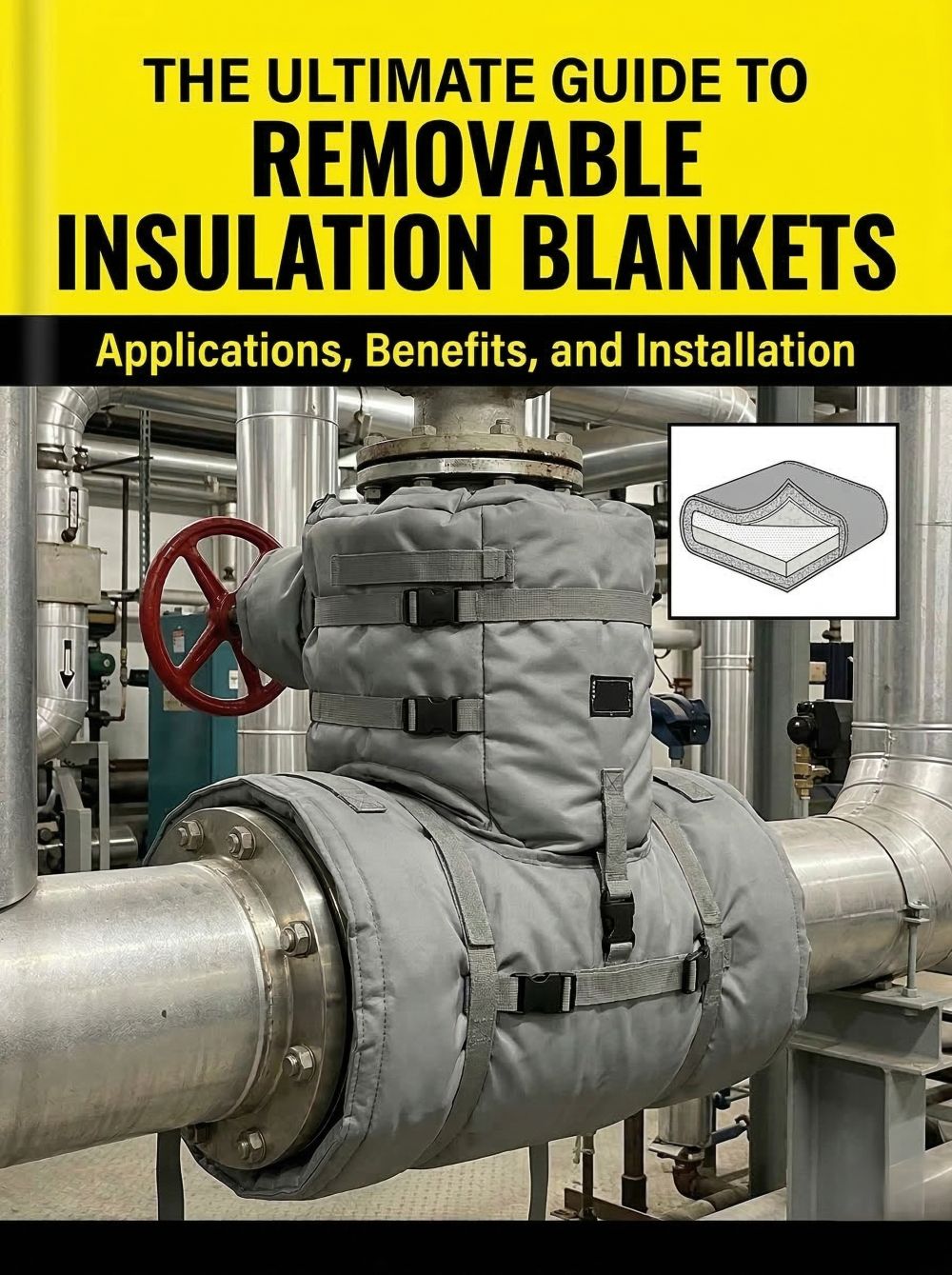
Industrial efficiency often hinges on the smallest details. While traditional "hard" insulation has served facilities for decades, its inherent rigidity creates a maintenance bottleneck. Every time a valve requires repair or a flange needs inspection, permanent insulation must be destroyed and replaced—at a significant cost in materials, labor, and downtime.
According to the U.S. Department of Energy, insulation can reduce energy losses from steam distribution components by up to 90%. Yet studies of mechanical and boiler rooms routinely find that valves, strainers, and pressure regulators are either partially insulated or completely bare—a problem that can account for roughly 8% of a building's total fuel use for heating.
This guide explores how transitioning to removable insulation blankets—also known as insulation jackets—can transform your facility's operational agility and thermal management strategy. You get the performance of permanent insulation with the flexibility of a reusable, precision-fit garment.
1. The Strategic Value of Removable Systems
Choosing removable blankets over traditional lagging offers measurable advantages across safety, maintenance, and finance:
- Zero-Waste Maintenance: Traditional insulation is typically discarded during repairs. Removable jackets can be taken off in minutes and reinstalled by any staff member, eliminating the need for specialized insulation contractors. Over the life of a system, this can cut maintenance-related insulation costs by 80% or more.
- Rapid ROI: Most custom systems pay for themselves in less than 12 months—and in many cases, as quickly as 3–6 months—through reclaimed energy and drastically reduced labor costs. The DOE's ASTM C1129 standard provides a formal methodology for calculating these heat savings on valves and flanges.
- OSHA Compliance & Personnel Safety: ASTM C1055 establishes that surface temperatures above 140°F can cause contact burn injuries within seconds of exposure. These jackets significantly lower the "touch temperature" of high-heat equipment, helping facilities meet OSHA 29 CFR 1910.261 and similar safety standards.
- CUI Prevention: Corrosion Under Insulation (CUI) is one of the most expensive failure modes in the process industries. Because removable blankets are easy to take off, they encourage more frequent visual inspections—catching rust, pitting, and wall thinning before they become catastrophic failures.
- Acoustic Damping: Beyond heat retention, insulation jackets act as effective sound mufflers for noisy turbines, pumps, and compressors. Many specifications now call for blankets with built-in noise-control barriers per DOE Steam Tip Sheet #17.
- Carbon & Emissions Reduction: Every uninsulated valve is a source of avoidable CO₂ emissions. One industry study found that insulating bare pipe components on a 25-building campus saved approximately 6 billion BTU annually, with proportional reductions in greenhouse gas output.
2. Common Industrial Applications
If a component has a complex geometry or requires periodic access, it is a prime candidate for a removable jacket. Here are the most common use cases:
- Flow Control: Gate, globe, butterfly, check, and control valves, as well as flanged joints. A single 6-inch gate valve can have more than 6 square feet of exposed surface area radiating heat around the clock.
- High-Heat Machinery: Pumps, turbines, and engine exhaust manifolds in power generation, marine, and oil & gas environments.
- Pressure Vessels: Heat exchanger heads, boiler manways, and expansion joints that need regular inspection access.
- Steam Systems: Steam traps—often the most neglected sources of massive energy loss in any plant. (Note: always consult the trap manufacturer's guidance, as some thermostatic trap types require specific insulation considerations.)
- Freeze Protection: Instrumentation, gauges, and exposed piping in cold climates. Removable blankets can be paired with electric or glycol heat tracing for year-round protection.
- Specialty Environments: Pharmaceutical, food-grade, and semiconductor facilities where PTFE-coated blankets support sanitary washdown protocols.
3. Technical Anatomy: The "Sandwich" Design
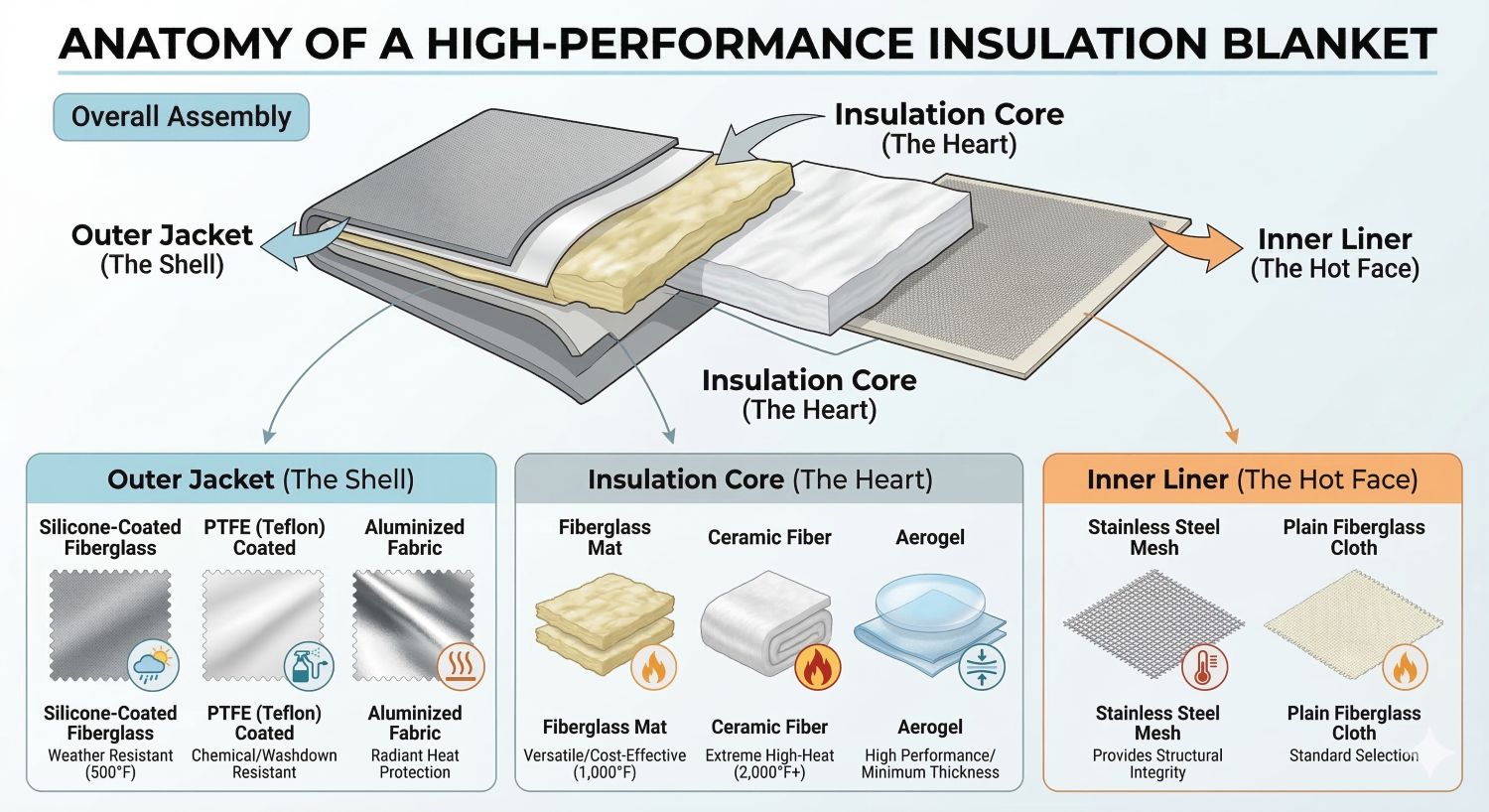
A high-performance insulation blanket is engineered as a three-layer system, with each material selected based on the specific thermal, chemical, and environmental conditions of the application.
The Outer Jacket (The Shell)
This layer protects the internal insulation from UV, moisture, chemicals, and physical abrasion.
- Silicone-Coated Fiberglass: The industry workhorse. Weather-resistant and durable up to approximately 500°F continuous exposure. Suitable for the vast majority of indoor and outdoor mechanical room applications.
- PTFE (Teflon®) Coated Fiberglass: Best for chemical processing or food-grade areas requiring caustic washdowns. Offers superior chemical resistance and a non-stick surface that resists contamination buildup.
- Aluminized Fabric: Highly reflective; specifically designed for environments with significant radiant heat loads, such as near furnaces and exhaust stacks.
The Insulation Core (The Heart)
This is the working layer that determines the blanket's thermal resistance (R-value). Material selection is driven by operating temperature, available clearance, and budget.
- Fiberglass Mat: A versatile, cost-effective choice for temperatures up to approximately 1,000°F. Products from manufacturers like Owens Corning and Johns Manville offer consistent K-values and excellent long-term performance.
- Mineral Wool / Rock Wool: Excellent for applications requiring both thermal performance and fire resistance. Hydrophobic mineral wool options (from manufacturers such as Owens Corning or Johns Manville) resist moisture absorption, which helps prevent CUI in outdoor installations.
- Ceramic Fiber: Engineered for extreme high-heat environments reaching 2,000°F and above—common around turbine casings, breechings, and certain reactor vessels.
- Aerogel: A high-tech, thin-profile material that provides maximum insulation in tight spaces. 3M and other manufacturers offer flexible aerogel sheets that deliver two to three times the R-value per inch compared to standard fiberglass—ideal when clearance is limited.
The Inner Liner (The Hot Face)
This is the layer in direct contact with the equipment surface. It must withstand the highest operating temperature and resist abrasion from repeated installation and removal.
- Stainless Steel Mesh: Provides structural integrity at extremely high temperatures and resists tearing. Common in turbine and exhaust applications.
- Plain Fiberglass Cloth: The standard selection for moderate-temperature applications below 500°F.
- E-Glass or Texturized Fiberglass: A middle-ground option that provides improved abrasion resistance over plain cloth without the cost of stainless mesh.
4. Comparison of Fastening Systems
A jacket's effectiveness is largely dependent on its fit and securement. Gaps and loose spots create thermal bridges that undermine the entire R-value of the blanket. ASTM C1695 provides fabrication requirements for removable/reusable blanket insulation, including fastener specifications.
|
Method |
Best For… |
Key Benefit |
|
Stainless Steel D-Rings & Straps |
Most industrial environments, outdoor installations, high-vibration areas. |
Most secure and durable. Resists loosening from thermal cycling and vibration. |
|
Velcro / Hook-and-Loop Flaps |
Indoor, low-to-moderate-heat areas where blankets are removed frequently. |
Fastest removal and reinstallation—ideal for weekly or daily access cycles. |
|
Lacing Hooks & Wire |
Traditional/heavy-duty setups, legacy installations. |
Very secure and tamper-resistant, though slower to remove. |
|
Drawstrings / Draw Cords |
Circular or small components such as pipe ends and small valves. |
Conforms tightly to irregular shapes. Simple, low-cost closure. |
|
Spring-Loaded Latches |
Applications with significant thermal expansion and contraction. |
Self-compensates for dimensional changes, maintaining consistent contact. |
Pro Tip: Many installations benefit from a combination approach—D-rings at the primary closure with Velcro seal flaps along the edges to eliminate air gaps. Ask your Insulation Guy representative about the best configuration for your equipment.
5. Applicable Standards & Specifications
Understanding the standards that govern removable insulation helps ensure your blankets perform as expected and satisfy engineering specifications.
|
Standard |
What It Covers |
|
ASTM C1695 |
The primary specification for fabrication of flexible removable and reusable blanket insulation for hot service (ambient to 1,000°F). Covers material requirements, fastener design, and construction methods. |
|
ASTM C1129 |
Provides the calculation methodology for estimating heat savings when thermal insulation is added to bare valves and flanges. The go-to standard for building an ROI case. |
|
ASTM C1055 |
Guide for heated system surface conditions that produce contact burn injuries. Establishes safe touch-temperature thresholds for personnel protection. |
|
ASTM C680 |
Standard practice for heat loss and surface temperature calculations. Used by the DOE's Steam Tip Sheet program to calculate energy savings from insulation. |
6. Insulation Material Selection Guide
Choosing the right core material depends on operating temperature, space constraints, chemical exposure, and budget. The following table provides a quick-reference comparison:
|
Material |
Max Temp |
Relative Cost |
Profile |
Best Application |
|
Fiberglass Mat |
~1,000°F |
$ |
Standard |
General-purpose steam & hot water systems |
|
Mineral Wool |
~1,200°F |
$–$$ |
Standard |
Outdoor & fire-rated applications |
|
Ceramic Fiber |
2,000°F+ |
$$ |
Standard |
Turbines, exhaust, furnace components |
|
Aerogel |
~1,200°F |
$$$ |
Ultra-Thin |
Tight clearances, space-constrained piping |
|
Microporous |
~1,800°F |
$$$ |
Ultra-Thin |
Extreme heat + space restrictions |
7. Procurement Checklist
Before requesting a custom quote from The Insulation Guy, gather the following technical data. The more information you provide up front, the tighter the fit and the better the thermal performance of your finished blankets.
- Operating Temperature: What is the consistent internal temperature of the equipment? Include both normal operating and peak/upset conditions.
- Environmental Factors: Is the installation indoors or outdoors? Will the blanket face UV exposure, salt spray, chemical splash, humidity, or oil/fuel mist?
- Access Frequency: How often will the jacket be removed—daily, weekly, during scheduled shutdowns, or only annually? This drives fastener selection.
- Clearance Constraints: Is there room for a standard 1–2 inch blanket, or is a thin-profile aerogel solution required? Measure the gap between the component and surrounding structures.
- Acoustic Requirements: Is noise reduction a primary or secondary goal? If so, specify the target dB reduction or reference the applicable facility noise standard.
- Dimensional Data: Provide pipe size (NPS), ANSI pressure class, valve make/model, and ideally field measurements or photos of the component from multiple angles.
- Regulatory & Spec Compliance: Note any owner or engineering specifications the blankets must meet (e.g., ASTM C1695, specific fire ratings, FDA food-contact requirements).
The Insulation Guy (Smock & Schonthaler) provides custom-measured, precision-fabricated blankets rated up to 1,500°F. We leverage insulation materials from trusted manufacturers—including 3M, Owens Corning, Armacell, Aeroflex, and Johns Manville—to ensure every blanket delivers a "glove-like" fit and maximum thermal performance for your specific application.
8. Maintenance & Lifecycle Best Practices
A well-constructed removable blanket can deliver years of reliable service. Follow these practices to maximize its useful life:
- Inspect on Removal: Each time a blanket is removed for maintenance, visually inspect both the blanket and the underlying equipment. Look for signs of moisture intrusion, fraying seams, hardened or compressed insulation, and corrosion on the equipment surface.
- Store Properly: When blankets are off the equipment, store them flat or loosely rolled in a dry area—never crumpled or stacked under heavy objects, which can permanently compress the insulation core.
- Clean as Needed: PTFE-coated blankets can be wiped down or pressure-washed for food-grade and pharmaceutical applications. Silicone-coated fiberglass can be brushed clean of surface debris.
- Replace Damaged Fasteners Immediately: A blanket with one broken D-ring or missing strap will not seat properly, creating thermal bridges that defeat the purpose of the insulation.
- Track Your Inventory: For large-scale installations, assign a unique ID number to each blanket tied to its corresponding equipment tag. This simplifies reinstallation and ensures blankets go back on the right component.
- Budget for Lifecycle, Not Just Purchase: Removable blankets have a dramatically lower total cost of ownership than traditional insulation. Factor in the avoided costs of repeated insulation demolition, disposal, and re-installation when evaluating your investment.
9. Get Started with The Insulation Guy
Whether you're insulating a single control valve or outfitting an entire boiler room, The Insulation Guy has the expertise and product range to deliver the right solution. Our process is straightforward:
- Thermal Survey: We conduct an on-site heat-loss assessment to identify the highest-impact opportunities in your facility.
- Custom Engineering: Every blanket is designed and patterned to your equipment's exact dimensions.
- Precision Fabrication: Blankets are manufactured using industry-leading materials from 3M, Owens Corning, Armacell, Aeroflex, Johns Manville, and other trusted brands.
- Installation Support: We provide installation guidance, dimensional documentation, and ongoing support.
Ready to stop wasting energy? Contact us today for a free consultation.