
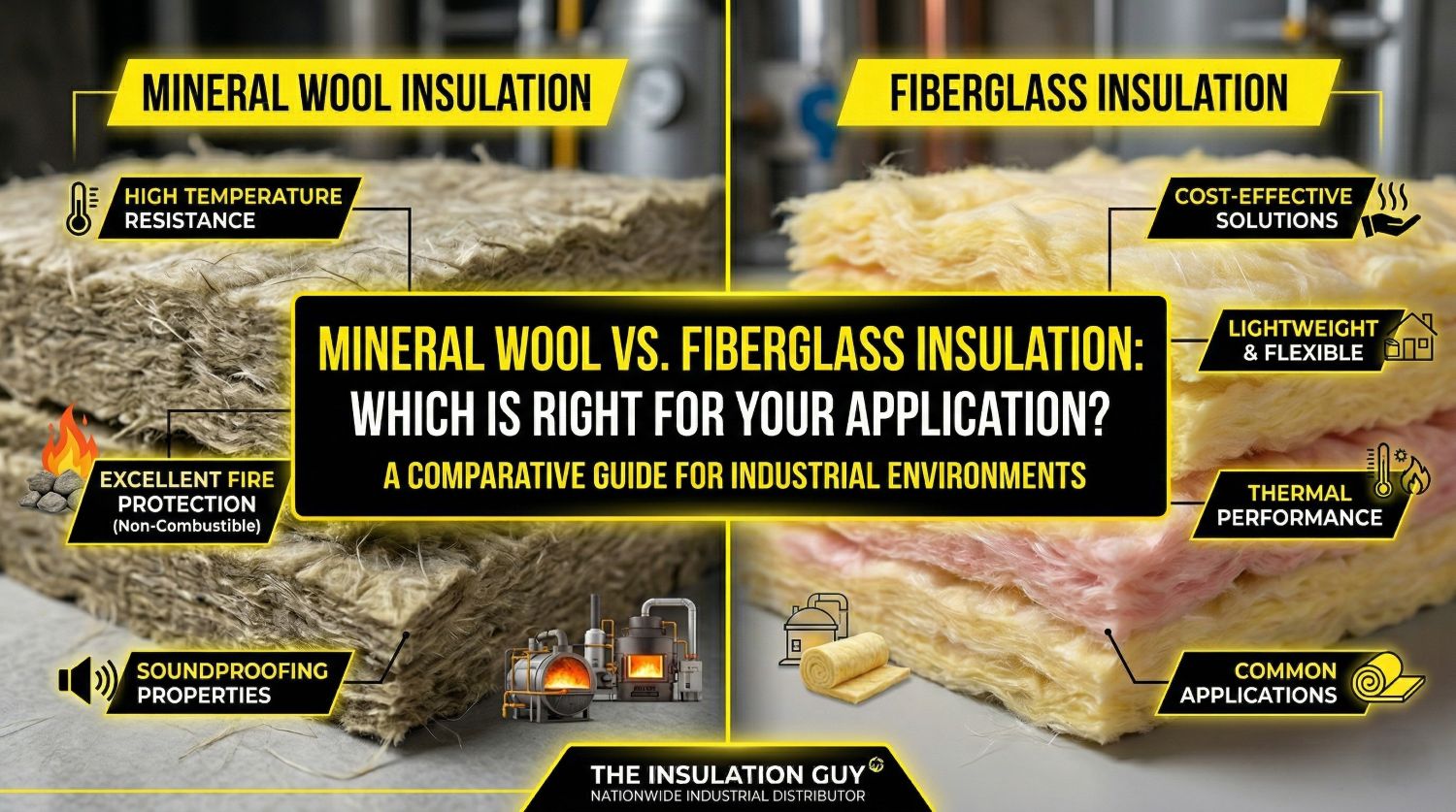
When it comes to insulating pipes, machinery and industrial systems, two materials come up more than any others: mineral wool and fiberglass. Both have earned their place in industrial settings over decades of use. Both come in batts, rolls and rigid forms. And both get the job done in a wide range of applications.
But they are not the same product — and specifying the wrong one for your application can cost you in energy losses, early replacement and, in some cases, real safety exposure.
Since 1989, The Insulation Guy has helped engineers, contractors and manufacturers find the right insulation solution for the job. Here is a straightforward look at both materials so you can make an informed decision.
What are they made of?
Fiberglass is made from melted glass spun into fine fibers and formed into lightweight batts or blankets. It is the most widely used industrial insulation material in the country, and its popularity comes down to availability and low upfront cost.
Mineral wool — also known as rock wool or sold under names like Rockwool — is made from basalt rock and recycled steel slag. Those materials are melted at high heat and spun into dense fibers, then compressed into batts or boards. The result is a heavier, stiffer product with a performance profile that is meaningfully different from fiberglass — especially in demanding industrial environments.
Thermal performance
Thermal control is often the primary reason people insulate in the first place. Lost energy is lost money, and the R-value of your insulation material is what determines how much energy you are retaining.
Mineral wool delivers an R-value of 3.0 to 3.3 per inch. Fiberglass comes in at 2.2 to 2.7 per inch. For a standard 3.5-inch application, that means R-15 with mineral wool versus R-11 or R-13 with fiberglass — a meaningful difference when you are trying to maintain process temperatures across long pipe runs or reduce heating and cooling costs in a large facility.
The practical benefit: you can achieve your target R-value with less material thickness, which simplifies installation in tight mechanical spaces and reduces the overall footprint of the insulation system.
Fire resistance
This is where the choice between these two materials carries the most weight for industrial applications.
Mineral wool can withstand temperatures up to 2,000°F without melting, smoking or spreading flame. Fiberglass begins to break down around 1,200°F. In refineries, manufacturing plants and facilities with open process heat or combustible materials in the environment, that difference is not a spec sheet detail — it is a personnel safety issue.
Mineral wool also functions as a passive fire stop, slowing the spread of fire through a structure and buying valuable time. Fiberglass, particularly when used with a kraft paper facing, does not offer that protection and can in some cases contribute to flame travel rather than resist it.
If protecting your employees and your equipment from fire risk is part of the equation — and in most industrial settings it should be — mineral wool is the stronger choice.
Moisture resistance
Mineral wool is hydrophobic by nature. Water runs off the surface rather than soaking in. Fiberglass absorbs moisture, and once it does, it loses R-value and creates conditions that support mold growth.
For outdoor pipe systems, below-grade applications, steam environments or any setting where condensation is a regular factor, this difference has real operational consequences. Wet fiberglass is not just less effective — it typically needs to be removed and replaced. That is an unplanned expense that better material selection could have avoided from the start.
Noise control
Both materials provide acoustic benefit, but mineral wool is significantly denser than fiberglass — and density is what determines how well an insulation material absorbs and blocks sound.
For industrial facilities managing noise compliance, or commercial and architectural applications where sound transmission class requirements apply, mineral wool is the material that can reliably meet those targets. If a project requires both thermal performance and noise reduction, mineral wool handles both without adding a second material to the spec.
Weight and ease of installation
Mineral wool weighs more. That is worth knowing before you specify it for overhead applications or any installation where the insulation will rest on gypsum board or lightweight framing. In those cases, fiberglass is the practical choice — it is lighter, more flexible and easier to work with around existing systems.
In pipe insulation, wall cavities and other fitted applications, though, mineral wool's rigidity tends to work in your favor. It has to be cut and fit correctly. It cannot simply be compressed around an elbow or an electrical penetration the way fiberglass often is in the field. That compression is one of the most common ways installed insulation underperforms — and mineral wool largely eliminates the problem by its nature.
Cost
Mineral wool typically costs 25 to 50 percent more than fiberglass at the time of purchase. That premium is real and should be part of any honest project estimate.
The full cost picture, though, includes how long the material holds up, how often it needs to be inspected or replaced and how much energy it conserves over the life of the system. Quality insulation typically pays for itself within two to three years through energy savings alone. Mineral wool's durability — particularly in wet or high-temperature environments — often makes it the more economical choice when you look beyond the initial purchase.
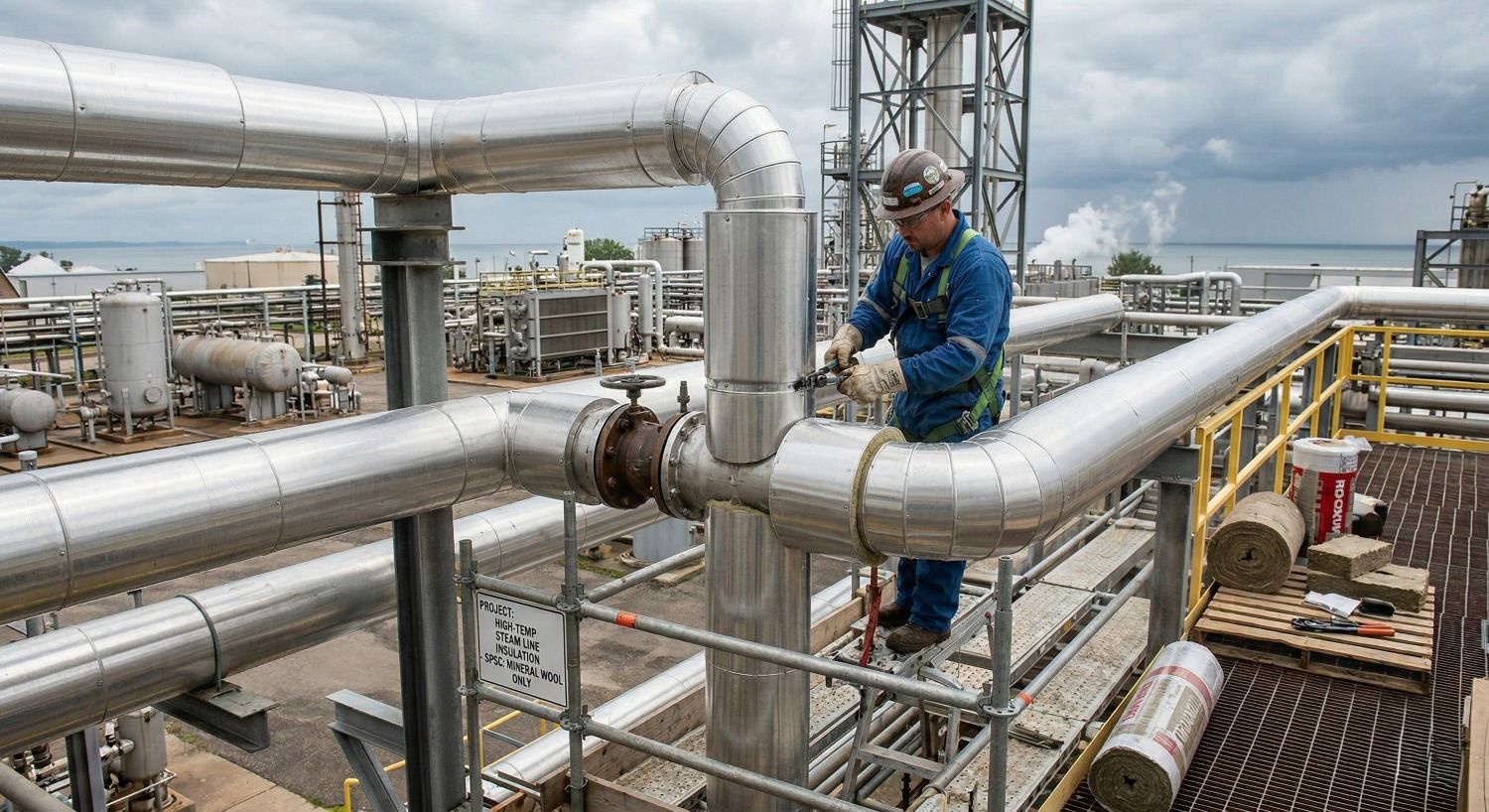
Which one is right for your project?
Specify mineral wool when:
- Operating temperatures exceed 1,000°F or fire exposure is a concern
- The installation is exterior or subject to moisture and condensation
- The project requires both thermal and acoustic performance
- Long-term durability is a priority over upfront cost savings
Specify fiberglass when:
- Budget is the primary constraint and operating conditions are controlled
- The application is interior, climate-controlled and within standard temperature ranges
- Weight is a limiting factor, such as overhead or attic installations
- A vapor-retarding faced product is required and the application does not call for mineral wool's fire or moisture performance
The right answer depends on what you are insulating, where it is located and what you need it to do. When in doubt, it is always better to consult with someone who knows the products and the application — before the job is underway, not after.
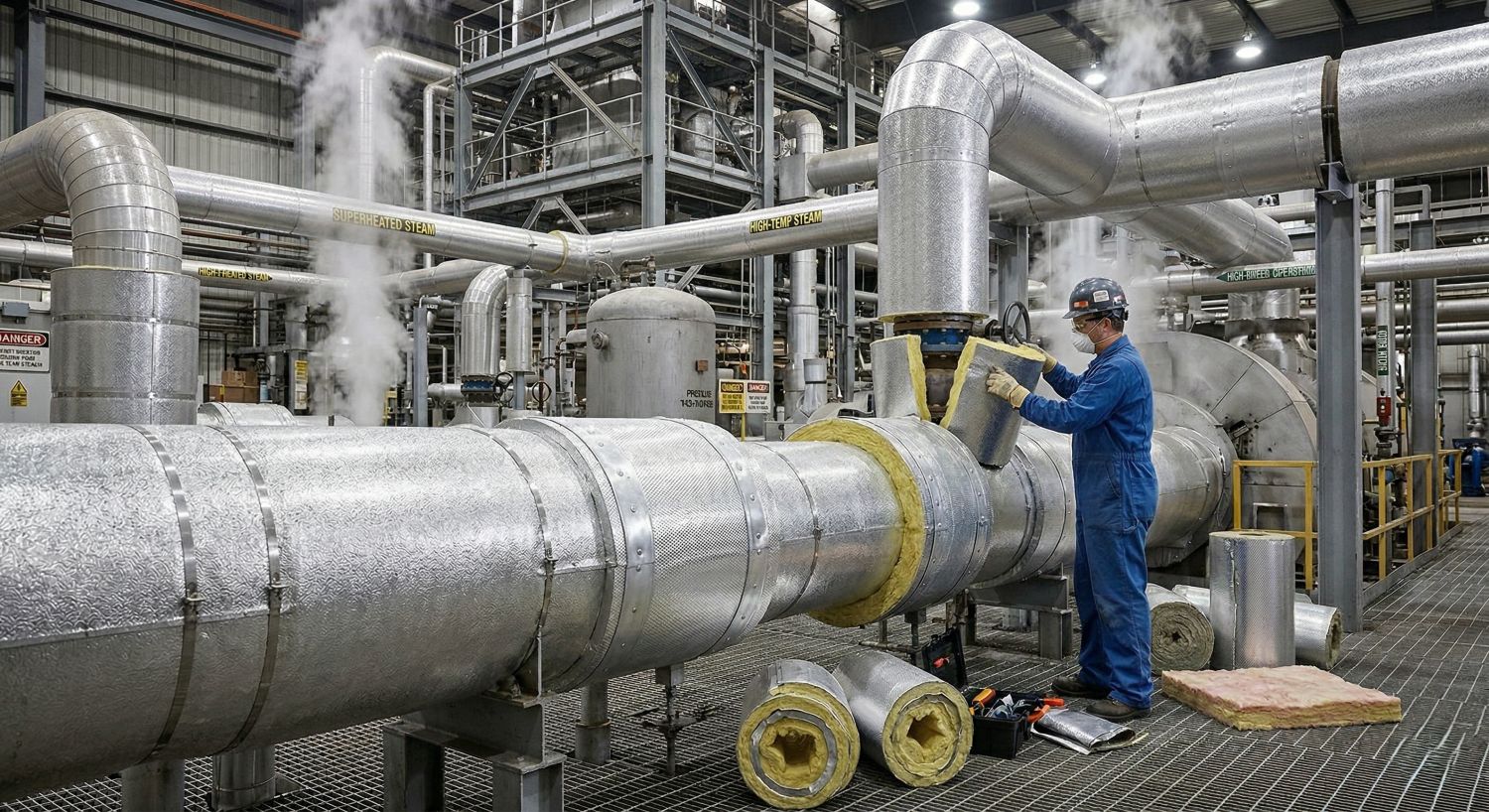
Material comparison at a glance
| Category | Mineral Wool | Fiberglass |
|---|---|---|
| R-value per inch | 3.0 – 3.3 | 2.2 – 2.7 |
| Fire resistance | Up to 2,000°F | Up to 1,200°F |
| Moisture resistance | Hydrophobic — water runs off | Absorbs water, loses R-value when wet |
| Sound absorption | Superior broadband absorption | Moderate, better at high frequencies |
| Recycled content | ~70% | 20 – 30% |
| Upfront cost | 25 – 50% higher than fiberglass | Lower upfront cost |
| Density / form | High — semi-rigid | Low — flexible |
| Best for | Exterior, high-temp, wet & noise-sensitive applications | Interior, climate-controlled, overhead & weight-sensitive applications |
We can help you get it right
The Insulation Guy has been matching contractors, engineers and facility managers with the right insulation products since 1989. We carry thermal insulation from Owens Corning, Johns Manville and other leading manufacturers, and our team is genuinely knowledgeable about how to solve your specific application — simple or complex.
Whether you are working on a pipe system, replacing aging insulation on process equipment or looking for an acoustic solution that also provides thermal control, give us a call. We ship nationwide and we are happy to talk through your project before you commit to anything.
Request a quote online or reach us at 800-734-8771. We will help you find the right product, the first time.